Malaysia has built a sophisticated digital payments ecosystem. Consumers can move money instantly, pay businesses digitally and choose from an expanding range of payment methods.
DuitNow Pay represents another step forward. But making the infrastructure available is only the beginning.
The next challenge is making it easy for businesses to adopt and use.
For banks, acquirers and payment technology providers, that means turning payment infrastructure into merchant ready experiences without adding unnecessary complexity.
Key Takeaways
- Infrastructure is the starting point. The real measure of DuitNow Pay’s success is whether merchants adopt it and customers use it.
- Merchant simplicity matters. Businesses want more payment options without managing more integrations, systems and operational processes.
- Banks do not have to build every layer. Technology partnerships can help banks extend DuitNow Pay while retaining ownership of their merchant relationships.
- Distribution drives adoption. The opportunity is to move from payment availability to merchant activation, transactions and repeat usage.
What Is DuitNow Pay?
DuitNow Pay is part of Malaysia’s real-time payments (RPP) ecosystem operated by PayNet. It enables businesses to offer online payments directly from customers’ accounts, including one time, repeat and recurring payments.
Behind this experience is a wider ecosystem.
PayNet provides the underlying infrastructure. Financial institutions participate as issuers and acquirers. Payment technology providers connect this infrastructure to merchant environments. Merchants then bring the payment experience to customers.
That final connection is where the next opportunity lies.
Malaysia Has Built the Rails. Now Comes the Last Mile.
Infrastructure availability and merchant adoption are two different milestones.
For businesses, DuitNow Pay needs to work within existing checkout, transaction management, reporting and reconciliation processes.
The challenge is that merchant needs vary.
A large ecommerce platform may have dedicated engineering teams and require greater control. An SME may prioritise a faster implementation with fewer technical requirements.
The same payment capability therefore needs to work across very different merchant environments.
The easier this complexity is to manage, the easier it becomes for businesses to adopt DuitNow Pay.
Merchants Do Not Want Another Payment Integration
A merchant’s goal is rarely to integrate DuitNow Pay.
They want to give customers more ways to pay, improve checkout and manage payments efficiently.
Yet businesses already manage cards, FPX, wallets and other payment methods. If every new method requires another integration, reporting environment and operational process, innovation creates more complexity.
DuitNow Pay becomes more useful when it can sit alongside the payment methods merchants already accept.
For banks, this changes the question from: how do we make DuitNow Pay available? To: how do we make it easy for merchants to adopt and manage?
The Banking Challenge: Build, Partner or Both?
Banks already bring trust, financial infrastructure, distribution and strong customer relationships.
But extending a new payment capability to merchants can require more than access to the payment rail. There is merchant onboarding, checkout integration, transaction management, reporting, reconciliation and ongoing operations.
Banks can build these capabilities internally. They can also work with payment technology providers for selected parts of the merchant experience.
The two approaches are not mutually exclusive.
Banks can retain ownership of their merchant relationships and commercial proposition while using specialised technology behind the scenes.
The strategic question is therefore not whether banks can build every layer.
It is where should banks build, and where can partnerships create greater value?
What Does Successful Adoption Look Like?
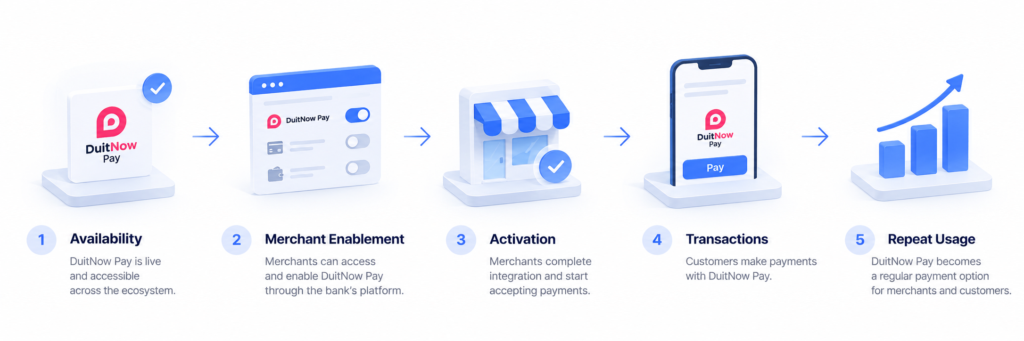
Availability is important, but it is not the end goal.
The goal is to ensure that DuitNow Pay moves closer to becoming part of everyday commerce.
Success should therefore be measured not only by how many merchants can access DuitNow Pay, but by how many activate it, transact with it and continue using it.
Bringing DuitNow Pay to Merchants with Razorpay Curlec
DuitNow Pay creates the opportunity. Razorpay Curlec helps banks bring that opportunity to their merchants under their own brand.
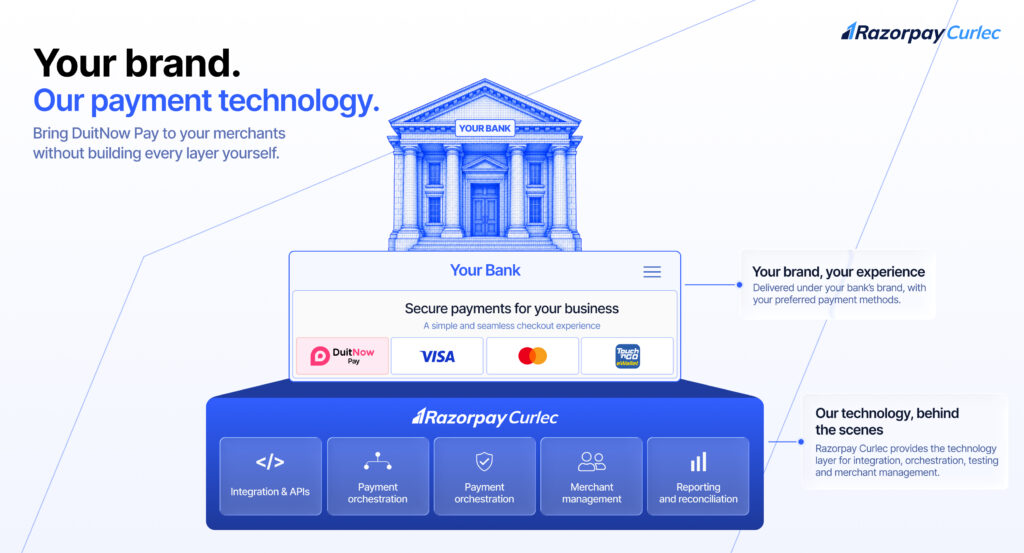
With our white label payment technology, banks can extend DuitNow Pay to their merchant base without having to build every layer themselves.
Razorpay Curlec provides the technology behind integration, payment orchestration, testing and merchant management, while the bank retains ownership of the merchant relationship and experience.
This means banks can offer a merchant facing payment proposition powered by Razorpay Curlec, but delivered under their own brand.
Because enabling DuitNow Pay is only the beginning. Making it easy for merchants to adopt is what drives usage.
From Infrastructure to Everyday Usage
Malaysia has built the rails. The next opportunity is getting those rails closer to businesses.
PayNet provides the infrastructure. Banks bring reach, trust and merchant relationships. Payment technology providers can help bridge the technology gap.
When these layers work together, DuitNow Pay can move from infrastructure availability to merchant adoption and everyday transactions.
Discover Razorpay Curlec Banking Solutions
Interested in exploring how Razorpay Curlec can help your bank bring DuitNow Pay to more merchants under your own brand? Get in touch with our team.
Frequently Asked Questions
1. What is DuitNow Pay?
DuitNow Pay is an online payment capability within Malaysia’s DuitNow ecosystem, operated by PayNet. It enables customers to pay online directly from their accounts through participating financial institutions.
2. What is the role of banks in DuitNow Pay?
Banks can participate as issuers and acquirers, helping customers make payments and merchants accept them. Their exact role depends on their participation within the PayNet ecosystem.
3. How can banks bring DuitNow Pay to their merchants?
Banks can build merchant facing capabilities internally, work with a payment technology provider, or use a combination of both approaches.
4. Does a bank need to build its own merchant payment infrastructure?
Not necessarily. Banks can retain ownership of their merchant relationships while using white label technology for capabilities such as integration, checkout, transaction management and payment operations.
5. How can Razorpay Curlec help?
Razorpay Curlec provides white label payment technology that helps banks extend DuitNow Pay to merchants under their own brand, while Razorpay Curlec powers the underlying merchant payment experience.